POSTLIVE ARRIVAL
1 T. REXINSIDE
Dinosaurs by Parcel Post.
Right now, the US Postal Service is carrying live baby chicks in the mail. They're descendants of dinosaurs, bred into breeds with blue eggs, black bones and tails longer than a car. Here's the catalogue.
A day-old chick can ride in a cardboard box through the mail for up to three days without food or water. Just before it hatches, it absorbs the last of the egg yolk, and that keeps it going. So hatcheries ship chicks across the country, peeping, by post.
It's one of the strangest things the mail does. It's also the most chicken thing possible: an animal so useful that people built the mail system around it, and so tough it survives being posted.
Chickens are probably the most common bird on Earth. They're also the closest thing most people will ever get to touching a dinosaur. And they come in breeds so strange they look made up: black inside and out, fluffy like a cat, tails metres long, eggs the colour of the sky.
Your backyard dinosaur
FIRST PRIZE // EVOLUTIONBirds are the one branch of dinosaurs that survived. A chicken's feet are covered in scales. Its wishbone, hollow bones and three forward toes are all dinosaur parts, and you can see them on a dinner plate.
In 2007 scientists pulled tiny fragments of protein out of a 68-million-year-old T. rex bone and compared them with living animals. Of the seven protein pieces they read, three matched chicken collagen. The team said the set as a whole looked closest to chicken.
The palaeontologist Jack Horner pushed the idea further in his book How to Build a Dinosaur (2009): the "chickenosaurus", a plan to switch on old dinosaur traits like tails and teeth in a chicken embryo. Nobody has hatched one.
From the jungle to the mailbox
SECOND PRIZE // HISTORYEvery chicken descends mainly from the red junglefowl, a wild bird of Southeast Asian forests. A 2022 study of chicken bones from more than 600 sites found that the earliest clearly domestic chickens turn up at Ban Non Wat in central Thailand, around 1650 to 1250 BCE. That's about 3,500 years ago.
The likely reason: rice and millet. Farmers stored grain, junglefowl came for the free food, and they never left. Chickens may have been kept for cockfighting and as special animals long before anyone thought of them as dinner.
Fast-forward to America. The Post Office started its parcel post service in 1913. Around the end of that decade, it began accepting live day-old chicks, as long as they could reach their destination within 72 hours.
A small-town banker in Webster City, Iowa named Murray McMurray had started selling chicks in 1917. Mail order meant he could sell far beyond his bank's customers. Murray McMurray Hatchery still ships chicks by mail today.
On September 10, 1945, a farmer in Fruita, Colorado named Lloyd Olsen chopped the head off a rooster for dinner. The rooster got up and kept walking. The axe had missed enough of the brain stem to keep him alive.
Olsen fed him with an eyedropper and took him on tour as Mike the Headless Chicken. Mike lived for about 18 more months. Fruita still throws a Mike the Headless Chicken Festival every year, and there's a statue of him on a street corner in town.
The breed catalogue
EIGHT BREEDS // EGG COLOUR DOTSEight breeds that prove chickens are weirder than you think. The dot is the egg colour.
Rhode Island Red
Rhode Island's official state bird. In 1925 a breed club put up a monument to the chicken in the village of Adamsville. It's on the National Register of Historic Places.
BROWNBEGINNER PICKAustralorp
A black hen with a green sheen. In a 1922–23 Australian laying trial, a team of six Australorps set a world record: 1,857 eggs in a year, about 310 each.
BROWNBEGINNER PICKSilkie
Feathers like fur, five toes instead of four, and black skin under the fluff. Silkies often go "broody" and will sit on any egg, even other birds'.
CREAMBEGINNER PICKAyam Cemani
Black feathers, black comb, black skin, even dark organs and bones, from a genetic condition called fibromelanosis. The eggs are ordinary cream.
CREAMAraucana / Ameraucana
Sky-blue eggs. Researchers traced the blue to an ancient virus that inserted itself into the chicken genome long ago. The colour goes all the way through the shell.
BLUEOnagadori
Roosters whose tail feathers never moult and keep growing for years, to many metres long. Japan has protected the breed as a Special Natural Monument.
CREAMSerama
One of the smallest chickens in the world, small enough to hold in one hand, and bred to stand upright like a tiny soldier.
CREAMLeghorn
The white egg machine behind most supermarket white eggs. Flighty, loud and very productive. Yes, the cartoon rooster was one.
WHITE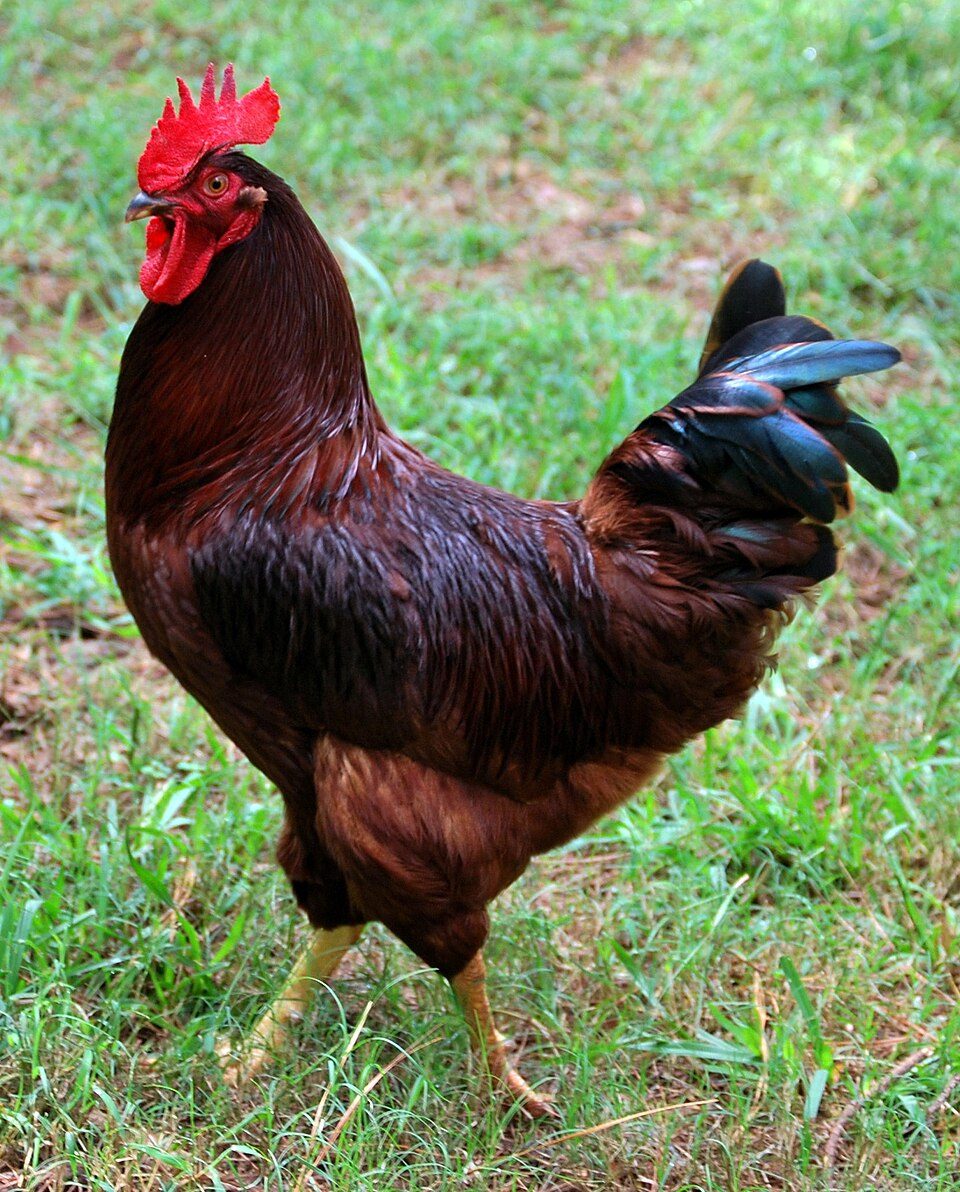
Best in show
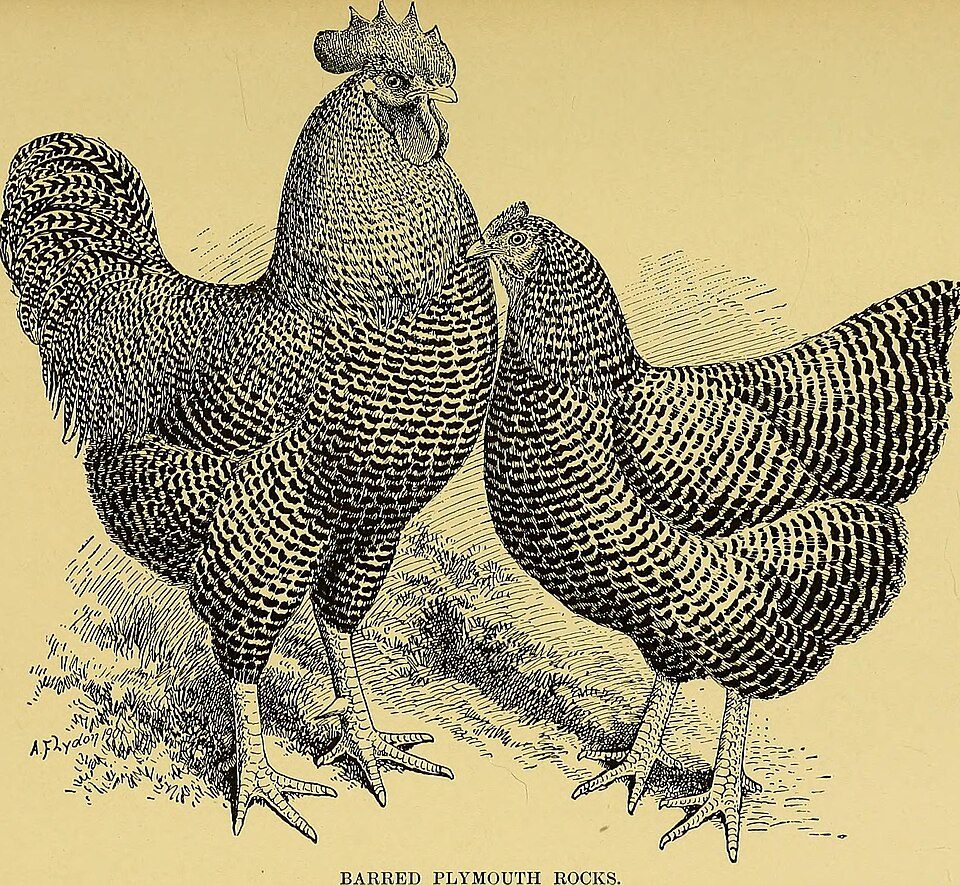
PRIZE LIST // THE STANDARDChicken shows are serious. The American Poultry Association was founded in 1873, and in 1874 it published the first Standard of Perfection: the rulebook for what every breed is supposed to look like, down to the comb, the feather colour and the angle of the tail. Judges still use it.
Roosters have rules too. A 2013 study in Japan found that roosters crow on an internal clock, not just at the first light. A follow-up found that in a flock, the top-ranked rooster crows first each morning, and the others wait their turn.
| CLASS | THE DEEP CUT |
|---|---|
| EGG COLOUR | Shell colour has nothing to do with nutrition. It's just the breed. |
| CANDLING | Holding an egg up to a bright light to see inside it. Hatcheries and egg graders have done it for over a century. |
| BROODY | A hen that stops laying and refuses to leave her nest. Some breeds go broody all the time. |
| COMB | The red crest. There are many standard types: single, rose, pea, walnut, buttercup and more. |
| BANTAM | A miniature version of a breed, roughly a quarter of the size. |
yep, that's me, at 5am, in a hoodie, being yelled at by the top-ranked rooster. you're probably wondering how i got here. two words: "fresh eggs."
Put these on
PEOPLE & PLACES // PPO- Mike the Headless Chicken Festival, Fruita, Colorado. A whole town party for a rooster who refused to quit.
- The Rhode Island Red Monument, Adamsville, Rhode Island. A 1925 roadside monument to a chicken breed. There's a rival marker a mile away, put up by the state in 1954.
- Murray McMurray Hatchery, Webster City, Iowa. Over a century of chicks by mail, with a catalogue that still reads like a breed encyclopedia.
- Koen Vanmechelen, a Belgian artist whose Cosmopolitan Chicken Project has spent decades crossbreeding chickens from different countries into one global bird. It's art about diversity, made out of chickens.
- The American Poultry Association, keepers of the Standard of Perfection since 1874. Their shows are where the weird breeds live.
Chick order form
TICK THE BREED THAT FITS YOUR LIFEWhich chicken person are you?
THE MATCHMAKERThe Breakfast Planner
AUSTRALORP · LEGHORNYou want eggs every day and you'll name them after the days of the week.
The Softie
SILKIEYou want something to hold. Silkies let you. They will also raise a duckling as their own.
The Aesthetic
AMERAUCANA · AYAM CEMANIBlue eggs in a bowl. An all-black bird in the yard. Your feed looks incredible.
The History Nerd
RHODE ISLAND REDYou visited the monument. You have opinions about the other monument.
The Show Kid
THE STANDARD OF PERFECTIONYou know your comb types and you've judged a bantam class in your head.
The Dinosaur Kid
ANY ROOSTERYou look at a chicken and see a T. rex. You're correct.
tl;dr
- Chickens are dinosaurs. T. rex protein fragments matched chicken collagen.
- Domesticated about 3,500 years ago in Southeast Asia, probably drawn in by rice and millet.
- Live chicks ship by mail. The yolk keeps them going for up to about 72 hours.
- Murray McMurray started in 1917 and still ships chicks.
- Blue eggs come from an ancient virus in the genome.
- The top rooster crows first. The others wait.
- Mike lived 18 months without a head. Fruita still celebrates.
- Beginner? Rhode Island Red or Australorp.


THE LEDGER
every hole in this manual, in one place. 8 doors. pick one. we're not responsible for where you end up.
OFFICIAL
- Murray McMurray Hatchery mcmurrayhatchery.comthe hatchery's own history, since 1917
- Mike the Headless Chicken Festival miketheheadlesschicken.orgFruita's festival for the rooster who refused to quit
- American Poultry Association amerpoultryassn.comkeepers of the Standard of Perfection
- Koen Vanmechelen koenvanmechelen.bethe artist behind the Cosmopolitan Chicken Project
RABBIT HOLES
- parcel post thecounter.orgThe Counter on how the mail learned to carry chicks
- Rhode Island Red Monument rhodetour.orgRhode Tour on the monument (and the rival)
READ
- T. rex scientificamerican.comScientific American on the 2007 protein match
- Ban Non Wat discovery.ucl.ac.ukthe 2022 study on where chickens came from
Made it to the end? You're a minion now.
New manuals drop every 13th. Get them first, read every one free, or slap a sticker somewhere to show you've been here.
found this printed somewhere? read it, then leave it somewhere weirder. field manuals are supposed to travel.