THECereal King's Horses
A breakfast-cereal millionaire, Valentino's movie horse, Arabians rescued from a Nazi stud farm, and a 1932 deed that still makes a university put on a horse show every month. The strangest ranch in Los Angeles County, and how to go see it.
In the hills east of Los Angeles there's a university that is legally required to keep breeding Arabian horses and putting on a horse show. Not because anyone voted for it. Because of the terms of a deed signed in 1932 by the man who made corn flakes.
The place is Cal Poly Pomona. Before it was a campus it was a winter ranch, and the ranch was a Hollywood hangout, a movie-horse stable, an Army war-horse depot and a landing spot for horses smuggled out of the end of World War II.
The horses never left. The W.K. Kellogg Arabian Horse Center is still on the grounds, the shows still run on Sundays, and you can buy a ticket for five dollars. This is the order of the show.
The cereal king's winter ranch
POMONA · 1925In 1925, Will Keith Kellogg, the Kellogg of the cereal box, from Battle Creek, Michigan, set up a winter home in Pomona and started what he'd always wanted: a serious Arabian horse breeding ranch.
He shopped at the top. Some of his foundation horses came from Lady Wentworth's Crabbet Arabian Stud in England, one of the most important Arabian breeders in the world at the time.
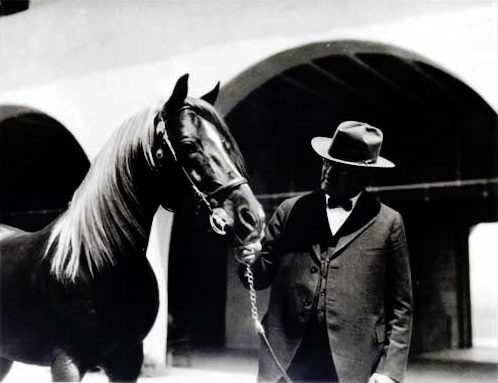
The ranch became a stop for the Hollywood crowd: stars of the day came out to pose for publicity photos with the horses. Kellogg's house on the hill, now called Kellogg House, was designed by Myron Hunt, the architect who also designed the Rose Bowl.
Valentino's horse
HOLLYWOOD · 1926Kellogg's horses went into the movies. The most famous was a grey stallion named Jadaan, ridden by Rudolph Valentino, the biggest heartthrob of the silent era, in The Son of the Sheik (1926).
It was Valentino's last film. He died that same year at 31. After that, people drove out to the ranch just to see the horse the Sheik had ridden.
The deed that won't let go
1932In 1932 Kellogg gave the ranch to the State of California. There were strings. The gift came on the condition that the Arabian breeding programme and the Sunday shows carry on.
Will Rogers, the cowboy philosopher who was one of the most famous entertainers in America at the time, was master of ceremonies when Kellogg handed over the deed to California's governor, in front of a crowd of about 22,000.
Almost a century later, the condition still holds. A presidential advisory committee on the Arabians meets twice a year because the deed says so.
Refugee horses
1943 – 1948During World War II the Army took over the ranch and bred horses for the cavalry. From 1943 it was the Pomona Quartermaster Depot, a remount station.
In the spring of 1945, US troops pulled off Operation Cowboy: they got hundreds of horses out of a German Army stud farm at Hostau, in what was then Czechoslovakia, before the Soviet advance reached it. Among them were Polish Arabians the Germans had seized.
In 1946, twenty-one of those Polish Arabians landed in Pomona, including the stallion *Witez II. He had carried a rider through the escape. In 1948 the Army quit the horse business and much of the stock was sold off.
The author Elizabeth Letts told the whole rescue in The Perfect Horse, and she dug through the W.K. Kellogg Arabian Horse Library on the campus to do it.
That library is one of the deepest Arabian horse archives anywhere: pedigrees, photos, postcards, ranch records going back to the 1920s. It's a whole rabbit hole sitting quietly next to the stables.
yep, that's me, on a ship out of europe with twenty horses who outran an army. you're probably wondering how i got here. two words: operation cowboy.
A century in bands
WHO HELD THE HILLSLong before anybody bred horses here, this was Tongva land, the people of the Los Angeles basin. Under Mexican rule it became part of Rancho San José. Then came the cereal king, then the Army.
In 1949, Cal Poly in San Luis Obispo took the ranch over as its southern branch and merged it with the Voorhis School, an agricultural school in nearby San Dimas. It went its own way in 1966 and became Cal Poly Pomona in 1972.
One tradition never split. Since 1949 the two Cal Polys have built a Rose Parade float together every single year, covered completely in flowers and other natural materials, as the Tournament of Roses requires.
What's on the grounds
RANKED BY HOW FAST YOU SHOULD GOThe Arabian Horse Center // est. 1925
The breeding programme Kellogg started, still going. The Sunday shows are the reason to come: Arabians performing in the arena the ranch built for exactly this.
The old Kellogg stables // c. 1926
The 1920s stable buildings are still part of the horse centre. Old Hollywood stood in these aisles.
Kellogg House // Myron Hunt
The cereal king's winter house, now used for events. Look at it from the lawn and imagine Valentino's horse down the hill.
The pointy building // 1993 – gone
For about 30 years the campus's best-known image was the CLA Building, a sharp, triangular tower by architect Antoine Predock. It looked so much like the future that it played one in the sci-fi film Impostor (2001), and it was the outside of Vincent's house in Gattaca (1997). It turned out to sit on an earthquake fault, so it was taken down. Since 2023 the spot has been a terraced park, with a pointed seating wall as a memorial.
The Lyle Center // regenerative studies
A working demonstration of how to live on land without using it up, named after the landscape architect John T. Lyle. Very different energy from the pointy building.
The Arabian Horse Library // special collections
The archive Elizabeth Letts used. Pedigrees, photos and postcards from a century of the ranch, in the university library's special collections.
Go see the horses
- Watched a Sunday show
- Found the 1920s stables
- Saw Kellogg House from the lawn
- Sat on the pointy wall
- Read up on *Witez II
- Told someone about the deed
tl;dr
- W.K. Kellogg, the corn flakes guy, started an Arabian horse ranch in Pomona in 1925.
- Valentino's horse Jadaan came from here, star of The Son of the Sheik (1926).
- The 1932 deed gave the ranch to California on condition the breeding and Sunday shows continue. They still do.
- WWII: an Army remount depot. In 1946, 21 Polish Arabians rescued at Hostau arrived here.
- 1949: Cal Poly arrives. The Rose Parade float tradition starts the same year.
- The pointy building was a sci-fi film set, sat on a fault and is now a park.
- Go: Sunday shows at 2 p.m., $5. The next one is Dec 6, 2026.

THE LEDGER
every hole in this manual, in one place. 10 doors. pick one. we're not responsible for where you end up.
OFFICIAL
- W.K. Kellogg Arabian Horse Center cpp.eduthe horses, the shows, the breeding programme
- Kellogg House kellogghouse.comthe cereal king's winter house, now an event venue
- Rose Parade float rosefloat.orgthe joint float, since 1949
- John T. Lyle cpp.eduthe Lyle Center for Regenerative Studies
- Sunday shows, 2:00 p.m. cpp.eduthe show schedule. check it before you drive
RABBIT HOLES
- Crabbet Arabian Stud oac.cdlib.orgthe ranch's own records, catalogued. pedigrees and all
- W.K. Kellogg Arabian Horse Library libguides.library.cpp.eduthe archive. a century of horses in boxes
READ
- Elizabeth Letts elizabethletts.comthe author of The Perfect Horse
- CLA Building thepolypost.comThe Poly Post on the park where the pointy building stood
LOOK
- Will Rogers homesteadmuseum.blogHomestead Museum's snapshots of the ranch, ca. 1925
Made it to the end? You're a minion now.
New manuals drop every 13th. Get them first, read every one free, or slap a sticker somewhere to show you've been here.
found this printed somewhere? read it, then leave it somewhere weirder. field manuals are supposed to travel.